


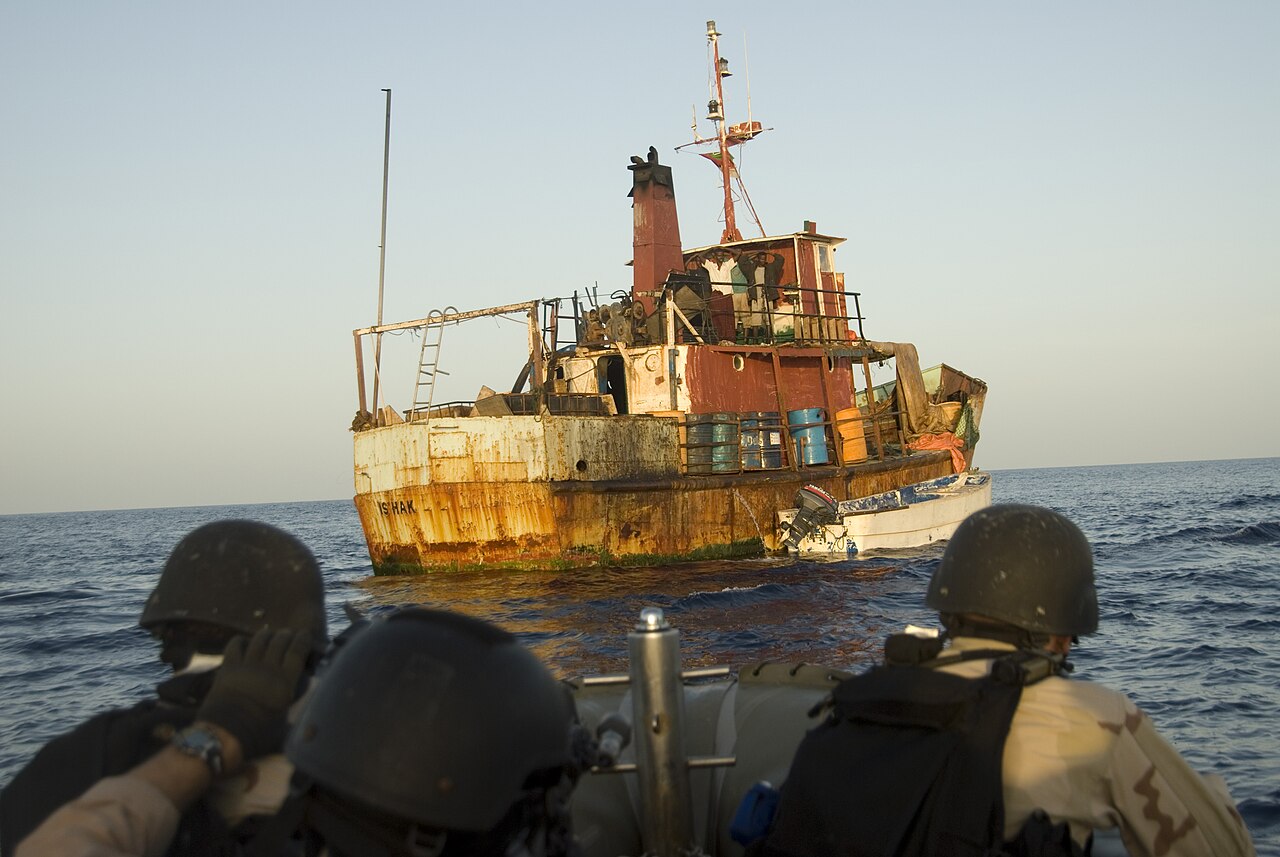
Two ships seized. Six days apart. The first in three years.
On April 21, 2026, six armed men stormed the oil tanker Honour 25, flagged to Palau, 30 nautical miles off the Somali coast. Five days later, a second cargo vessel was seized 6 nautical miles northeast of Garacad (~600 km north of Mogadishu) and redirected into Somali territorial waters. Somali piracy is no longer history.
The Honour 25 was carrying 18,500 barrels of oil and a crew of 17: ten Pakistanis, four Indonesians, one Indian, one Sri Lankan, one Myanmar national. The second vessel had 15 crew members — two Indians and 13 Syrians. Thirty-two sailors are now held by Somali pirates.
On April 26, the Joint Maritime Information Center (JMIC) upgraded the threat level for the Somali Coast and Somali Basin to “substantial” — the agency’s term for a situation where an attack is a “strong possibility.” “An oil-products tanker is reported to be held by pirates on the northeastern Somali coast. No injuries have been reported. Separately, a Pirate Action Group (organized piracy crew) is reported to be active in the Somali Basin. Vessels in the vicinity are advised to maintain heightened vigilance,” the JMIC stated in its April 26, 2026 update.
The UK Maritime Trade Operations authority (UKMTO) confirmed the second vessel’s seizure. “Unauthorized persons” had taken control and redirected it toward Somali shores. UKMTO urged all vessels in the area to transit with caution and report any suspicious activity.
The week brought additional incidents. On April 23, a Somali-flagged fishing vessel was hijacked near Xaafuun (~1,000 km north of Mogadishu, Africa’s easternmost point). An attempted armed boarding took place 83 nautical miles off Eyl (~580 km north of Mogadishu). Pirate Action Groups are active across the region.
THE FALL AND THE RETURN
Somali piracy reached its peak between 2008 and 2011. More than 200 attacks were recorded in 2011 alone. The model was simple: seize a vessel, hold the crew, demand a ransom.
International naval coalitions dismantled the threat. The European Union’s Operation Atalanta and NATO task forces drove attack numbers close to zero. By 2020, Somali piracy appeared finished.
In April 2024, a $5 million ransom was paid for the release of a vessel called the Abdullah. The payment sent a signal that could not be ignored: hijack-for-ransom still worked.
A VACUUM FILLED BY PIRATES
The method has evolved. Pirates now operate at unprecedented distances, using captured dhows (traditional Indian Ocean sailing vessels) as motherships. These vessels project force 300 to 600 nautical miles from the Somali coast — sometimes 800.
The resurgence arrives at a moment of extreme regional pressure. The Strait of Hormuz has been closed to shipping since the war between the United States, Israel, and Iran began. Nearly 1,000 ships and 20,000 crew members are stranded in the Arabian Gulf. The US is maintaining a naval blockade in the Arabian Sea.
Naval resources devoted to counter-piracy operations have been diverted toward monitoring regional conflicts. Somali pirates have filled the gap.
Fuel prices in Mogadishu have tripled since the conflict began, making tankers carrying fuel an especially attractive target. The European Union extended Operation Atalanta through 2027, with 43 piracy incidents already recorded in the past year.
Full report: Seatrade-Maritime, April 27, 2026.