


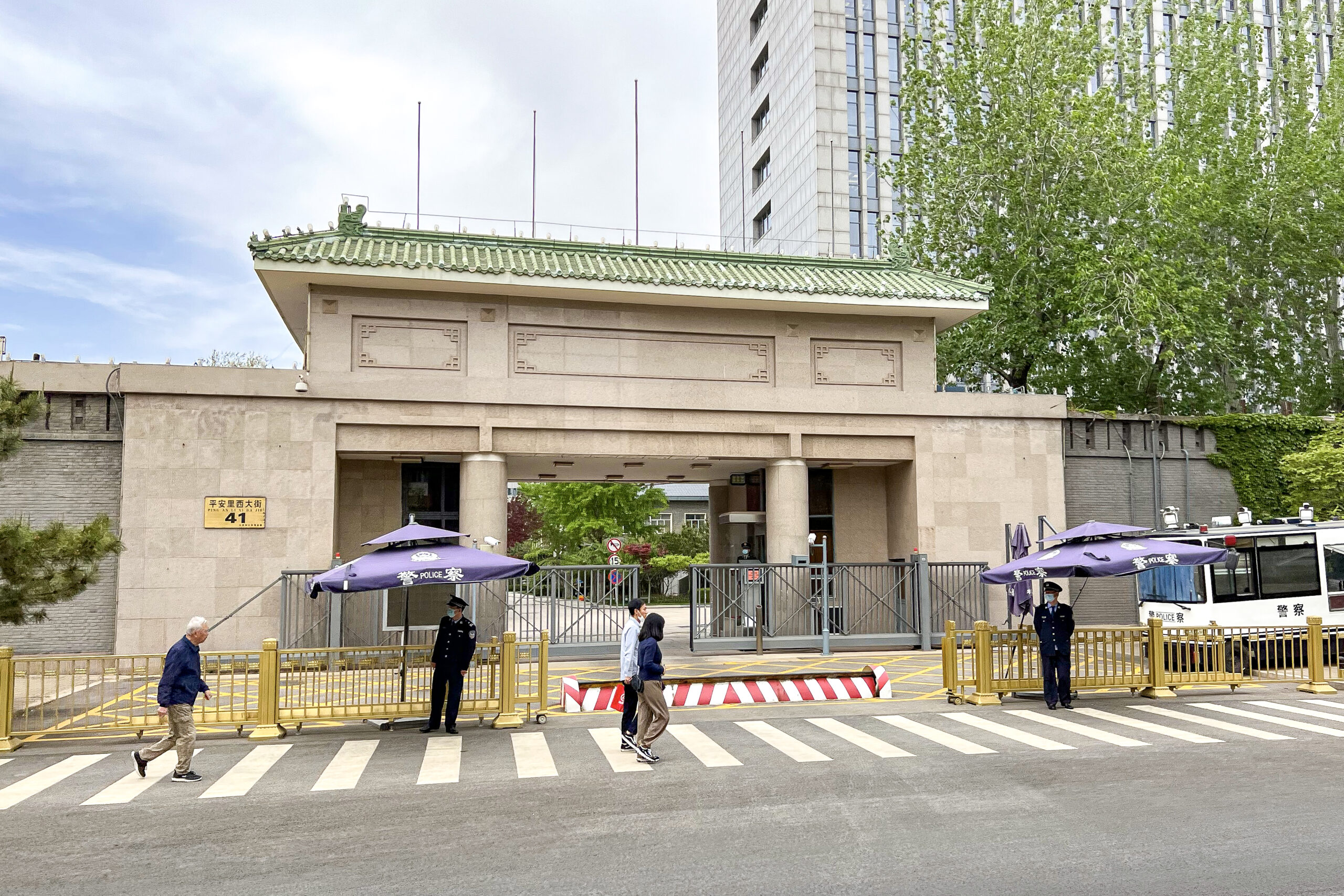
China has formally charged Gao Yichen, the former deputy director of the state agency responsible for eradicating religious cults. According to prosecutors, he allegedly turned that very office into an extortion network — precisely the kind of secretive, coercive organization he was paid to destroy.
A MANDATORY CAVEAT
This story comes from China. That means it has been approved by the government of the Chinese Communist Party. The CCP has a well-documented history of eliminating political rivals through carefully timed corruption charges. The courts that will try this case are not independent of the Party. Everything that follows should be read with that reality firmly in mind.
The Supreme People’s Procuratorate announced the formal prosecution on May 15, 2026. The case has been assigned to the Hangzhou Intermediate People’s Court in Zhejiang Province (about 170 km southwest of Shanghai). Prosecutors allege — if the charges are accurate — that the amounts received illegally were “particularly enormous.” The charges: bribery and influence peddling.
FROM SPYMASTER TO INQUISITOR
Gao was no ordinary bureaucrat. Before heading the state office formally named the Central Leading Group for Preventing and Dealing with Heretical Religions — universally known as the 610 Office — he had served as Vice Minister of State Security. He was, in other words, a senior figure in China’s intelligence apparatus, with years of overseas intelligence work. He studied Russian at Heilongjiang University (in northeastern China) starting in 1972.
The office he came to lead was created in 1999 out of panic. Tens of thousands of Falun Gong practitioners had managed to mobilize outside the Party leadership compound in Beijing without the security services detecting anything. For the CCP, the humiliation was severe. The response: a new extrajudicial bureau with powers that superseded courts, prosecutors, and all local governments.
According to prosecutors — if the allegations hold up — Gao turned that bureau into a personal enrichment machine.
WHAT HE IS ACCUSED OF
According to the official statement quoted by Jiemian News, Gao allegedly manipulated the approval process for company IPO listings, interfered in the transfer of state land use rights, blocked or accelerated the enforcement of civil court judgments for payment, and accepted free vehicles, cash and gifts from private business operators in exchange for favors.
The Party’s Central Discipline Commission expelled him in January 2026, accusing him of “severely polluting the political ecology” — coded language for building a web of personal loyalties inside the state apparatus — and “resisting organizational review,” meaning, in plain language, that he allegedly attempted to obstruct the investigation itself.
THE INSTITUTIONAL IRONY
The 610 Office was built to hunt organizations that demanded blind loyalty, operated in secrecy, and extracted money from their members. If the charges against Gao hold up, his own bureau became exactly that.
Prosecutors allege that inside his network, certain officials’ primary loyalty ran to Gao rather than to the Party. For Beijing’s leadership, that is the ultimate transgression: not merely stealing money, but using corruption to build a parallel power structure — precisely what the 610 Office was created to prevent.
The discipline commission’s official document describes a man who “lost his ideals and beliefs, abandoned his original mission, and had no political consciousness or political discernment.”
AN EXTRAJUDICIAL ARREST FOR AN EXTRAJUDICIAL CZAR
Gao was detained on June 9, 2025, under a procedure called liuzhi — a detention mechanism exclusive to the Central Discipline Commission. It allows authorities to hold a person without access to a lawyer or family for up to six months. It is precisely the type of extrajudicial confinement the 610 Office itself routinely used against its targets.
He was expelled from the Communist Party on January 20, 2026. The case was then transferred to the procuratorate — a step that in China almost invariably precedes a guilty verdict.
The 610 Office — named for its founding date of June 10, 1999 — was officially dissolved in 2018. Its former officials, evidently, were not. According to prosecutors, Gao never stopped his illicit activities after retirement. The discipline commission describes this behavior with its own bureaucratic poetry: “retiring without resting.”