

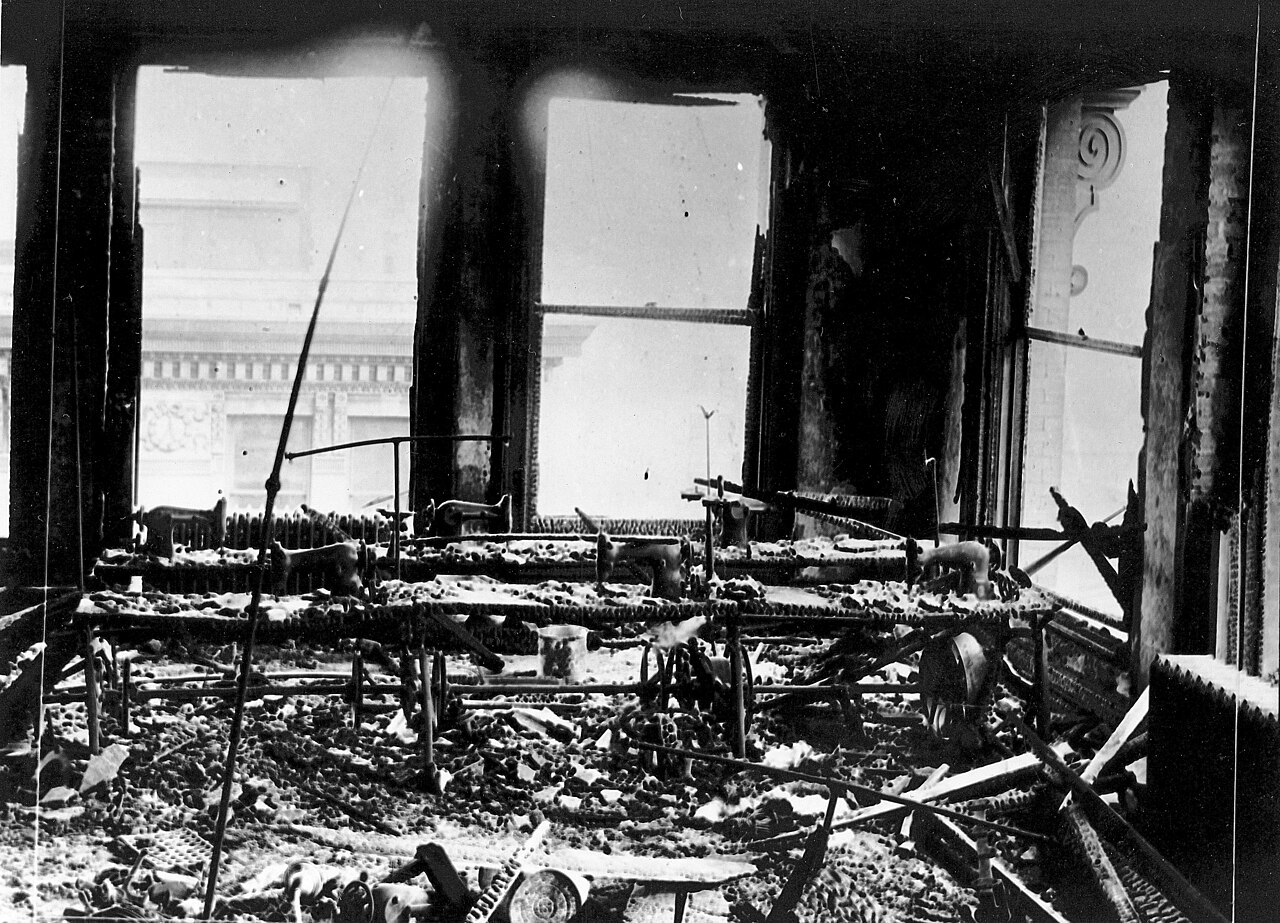
On March 25, 1911, a fire broke out on the eighth floor of the Asch Building in Greenwich Village, Manhattan. The Triangle Waist Company employed five hundred workers across three floors. The exit doors were locked. One hundred and forty-six people died in under eighteen minutes.
Most of the victims were young Jewish and Italian immigrant women, aged fifteen to twenty-three. Sixty-two of them jumped from the windows of the eighth and tenth floors. Fire department ladders reached only to the sixth floor. Bodies accumulated on the sidewalk of Washington Place.
The factory owners, Isaac Harris and Max Blanck — known as the “Shirtwaist Kings” — had locked the exits for years. The practice was intended to prevent workers from stealing fabric scraps and leaving their stations without permission.
The building had no sprinkler system. Its single exterior fire escape collapsed under the weight of fleeing workers in the first minutes of the fire.
Acquittal
On December 27, 1911, after a twenty-three-day trial, a jury acquitted Harris and Blanck of any criminal responsibility. Their insurance company paid them $60,000 — $400 per life lost. Their actual property losses had been less than that amount.
Twenty-three families of victims filed a civil suit. A judge awarded $75 per death.
“The life of men and women is so cheap and property is so sacred. There are so many of us for one job it matters little if 146 of us are burned to death,” said Rose Schneiderman, organizer for the Women’s Trade Union League, according to the Cornell University ILR School Triangle Fire Project published on 2 April 1911.
In August 1913, Max Blanck was arrested at his new factory on 23rd Street in Manhattan. The exit doors were locked during working hours. The judge fined him twenty dollars, then apologized for the severity of the penalty.